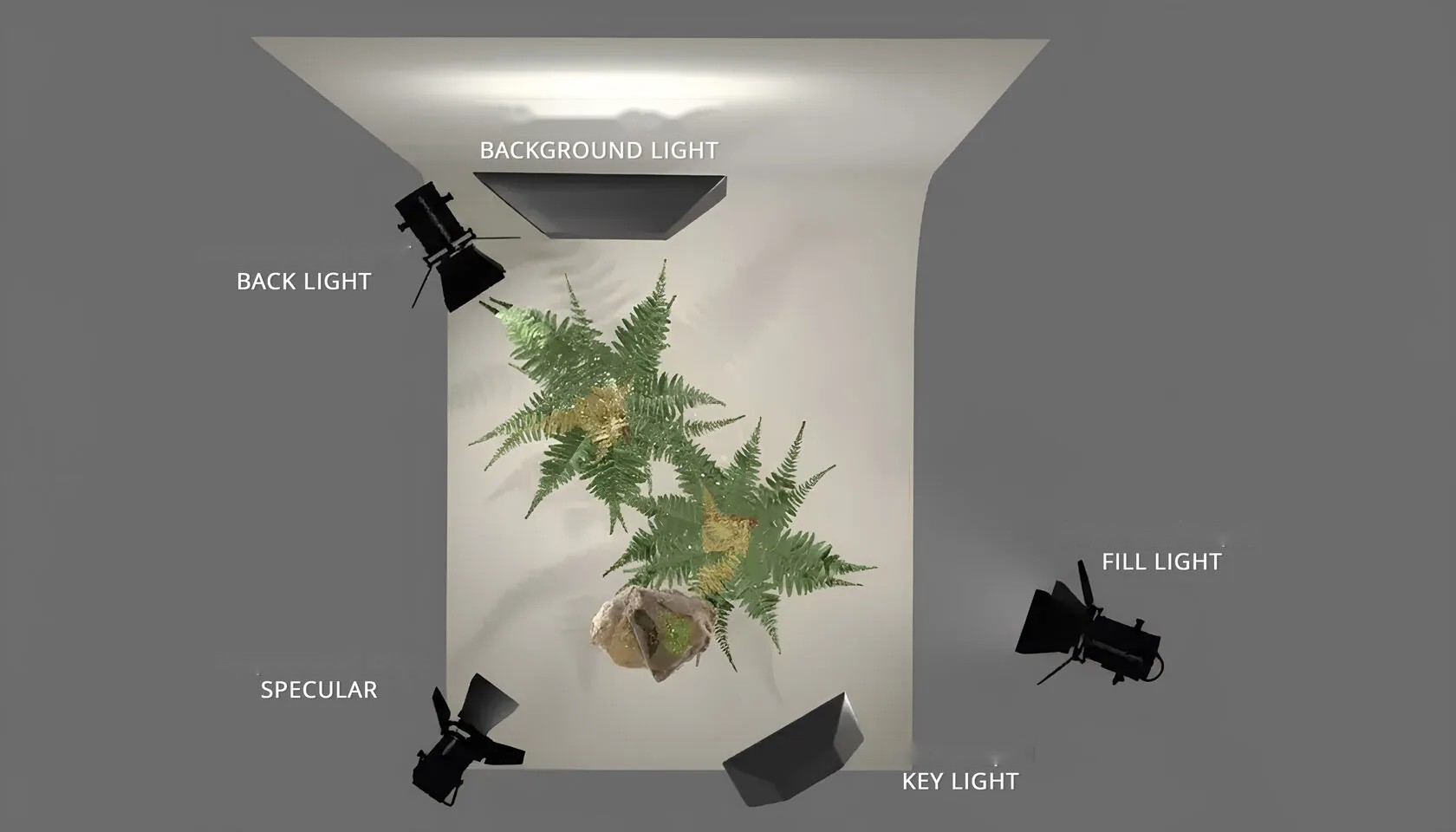
This setup gives you realistic, expressive lighting with volume, depth and emphasis.
It consists of 5 main lights:
- Key Light
- Fill Light
- Rim / Back Light
- Background Light
- Accent / Hair / Specular Light
1️⃣ Key Light
- Role: the main light source; it shapes the pattern of light and shadow.
- Position: at roughly 45° from the camera and slightly above the subject.
- Type: an Area Light or a Spot Light with soft shadows.
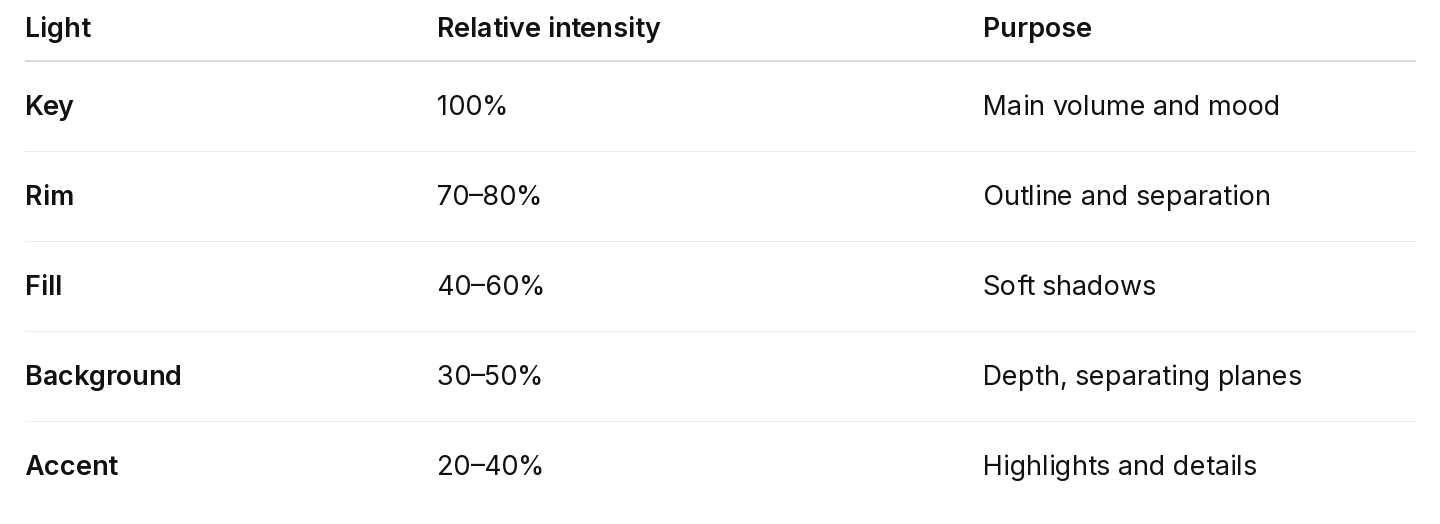
- Brightness: 🔆 the strongest (100%).
- Color: neutral or slightly warm.
- Redshift tip: for realistic gradients, use an Area Light 1–2 m in size — its shadow softness depends on its size. For a Spot Light, soften the shadows with the Softness parameter (around 0.2–0.4) on the light’s Details tab.
2️⃣ Fill Light
- Role: softens the shadows from the key light and brings out detail in the dark areas.
- Position: on the opposite side of the camera, lower and weaker.
- Type: a soft Area Light or a Dome Light with an HDRI.
- Brightness: 💡 40–60% of the key light.
- Color: slightly cooler than the key light (for a color temperature contrast).
- Tip: you can use a bounce card or Light Linking to light only the subject without affecting the background.
3️⃣ Rim Light / Back Light
- Role: separates the subject from the background and adds a nice highlight along its edge.
- Position: behind the subject, aimed slightly toward the camera.
- Type: a narrow Spot or Area Light.
- Brightness: 💡 70–80% of the key light (sometimes even higher if you need a bold outline).
- Color: can be contrasting — cool if the key light is warm.
- Tip: don’t overdo it — you want a clean outline of light, not a “halo”.
4️⃣ Background Light
- Role: lights the background, adds depth and separates the planes.
- Position: aimed only at the background, often from behind the subject.
- Type: a Spot, an Area Light or even a plane with an emissive material.
- Brightness: 💡 30–50% of the key light.
- Color: can be slightly darker or a gradient (for atmosphere).
- Tip: the background light is often made slightly cooler so that a subject in warm light stands out more.
5️⃣ Accent Light (Accent / Hair / Specular)
- Role: adds shine and accentuates details (for example, a logo, a surface, eyes, highlights).
- Position: aimed locally at an interesting part of the subject.
- Type: a narrow Spot or a small Area Light.
- Brightness: 💡 20–40% of the key light, but it can be very concentrated.
- Color: depends on the task — often slightly warmer.
- Tip: you can use Light Linking so that it only affects a specific material (for example, reflections on plastic or metal).
Brightness ratios (relative values):